
When to Stop, Pause, and Reset: Learning to De‑Escalate a Fight in Your Relationship
Arguments are normal in any relationship. What makes the difference is not whether you fight, but how you fight—and, crucially, when you know to stop, pause, and reset. At Couples Corner Counselling, we often see partners who intend to resolve an issue but end up escalating into blame, harsh words, or stonewalling. With a few deliberate strategies, you can turn a destructive fight into a chance to repair and grow closer.
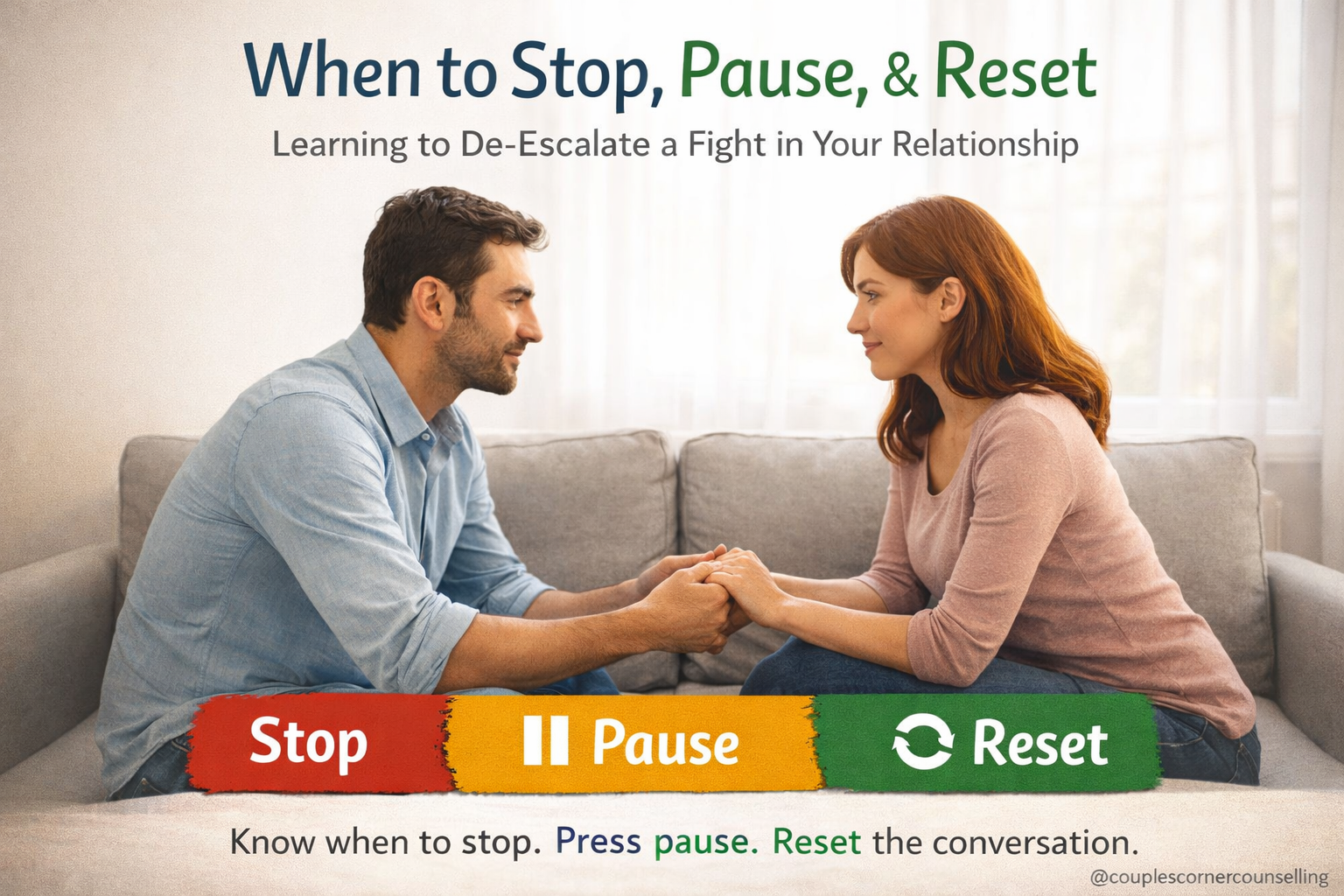
Healthy couples don’t avoid conflict; they learn to regulate it.
Learning to pause in the moment can turn conflict into connection.
Why Knowing When to Stop Matters
Healthy couples don’t avoid conflict; they learn to regulate it. Research into couples therapy shows that the presence of conflict is far less predictive of relationship success than how partners handle stress, anger, and misunderstandings (Gottman & Silver, 2015; Johnson & Indovina, 2013). When tension rises—heart rate increases, voices get louder, or one or both partners feel flooded—this is usually the signal that it’s time to stop arguing and reset the conversation (Gottman & Silver, 2015).
Put simply: if you can’t listen, you can’t resolve.
Signs It’s Time to Press Pause
Here are common signs that you’ve crossed into “too heated” territory and need to pause:
One or both of you are speaking in a raised or sarcastic tone.
You feel emotionally “flooded” or overwhelmed, as if you can’t think straight.
You’re stuck in a loop of repeating the same points or accusations.
One or both of you have shut down or started stonewalling (silent withdrawal).
When you notice these signs, the healthiest move is not to “win” the argument, but to stop and come back later when you’re calmer. This is not avoidance; it’s strategic self‑regulation (Gottman & Silver, 2015; Johnson & Indovina, 2013).
How To Pause Without Stonewalling
A simple “We need a break” can backfire if it feels like abandonment or rejection, but research on Emotionally Focused Therapy (EFT) shows that structured pauses followed by gentle re‑engagement can strengthen emotional safety in relationships (Johnson, 2019; Johnson & Indovina, 2013). To pause effectively:
Name it together.
You might say: “I can feel this conversation heating up. Can we pause for 20 minutes and come back calmer?” Saying this from a place of care, rather than anger, helps your partner feel partnered instead of attacked.Agree on timing.
Set a clear return time: “Let’s take 15 minutes, then pick this back up.” This keeps the conversation from being dropped indefinitely.Use the time to regulate, not ruminate.
Instead of rehearsing your next argument, focus on calming your nervous system: deep breathing, a short walk, a glass of water, or a brief check‑in with yourself (“What am I really feeling beneath the anger?”).Signal readiness to reconnect.
When you’re ready, re‑initiate the conversation gently: “I feel calmer now. Can we finish what we started?” This teaches your nervous system and your partner that conflict can be paused and then repaired
After the Pause: How to Reset
Coming back to the conversation is where real repair happens. A few key steps can help:
Start with validation.
Begin with something like: “I’m sorry we got so heated before. I still care about what you’re saying.” Validation doesn’t mean agreeing; it means acknowledging your partner’s feelings and perspective.Use “I” statements.
Instead of “You never listen,” try “I feel unheard when I’m cut off.” This keeps the focus on your experience and reduces defensiveness (Gottman & Silver, 2015; Markman et al., 2010)..Narrow the topic.
Pick one issue to resolve at a time instead of bringing up every past grievance. This makes solutions feel achievable and less threatening.Focus on what you want, not only what you don’t.
Rather than “Stop doing X,” try “I’d feel more supported if we could…” This helps you move from criticism to clarity.
Why This Matters For Your Relationship
When couples learn to stop, pause, and reset, they protect both the immediate conversation and the long‑term health of the relationship. Over time, this builds trust that “we can get through a fight and still come back to each other.” It also reduces the risk of contempt, chronic conflict, and emotional distance that often push couples out of therapy.
At Couples Corner Counselling, we specialize in helping partners develop exactly these skills: recognizing when emotions are escalating, learning ways to pause effectively, and rebuilding the conversation with respect and care.
If you and your partner often find yourselves stuck in the same heated arguments, you don’t have to figure it out alone. Couples Corner Counselling offers practical, compassionate support to help you learn how to stop, pause, reset, and reconnect in healthier ways.
👉 Book your session today at our secure online booking portal: https://thecouplescorner.janeapp.com/
📞 Or call us at 506‑889‑6017 to schedule an appointment.
Gottman, J. M., & Silver, N. (2015). The seven principles for making marriage work: A practical guide from the country’s foremost relationship expert (2nd ed.). Harmony Books.
Johnson, S. M. (2019). Attachment theory in practice: Emotionally focused therapy (EFT) with individuals, couples, and families. Guilford Press.
Johnson, S. M., & Indovina, L. (2013). The clinical practices of emotionally focused couples therapy. Journal of Marital and Family Therapy, 39(4), 483–500.
Markman, H. J., Rhoades, G. K., Stanley, S. M., & Allen, E. S. (2010). Prevention and early intervention to improve marital outcomes. Journal of Family Psychology, 24(5), 595–605.